
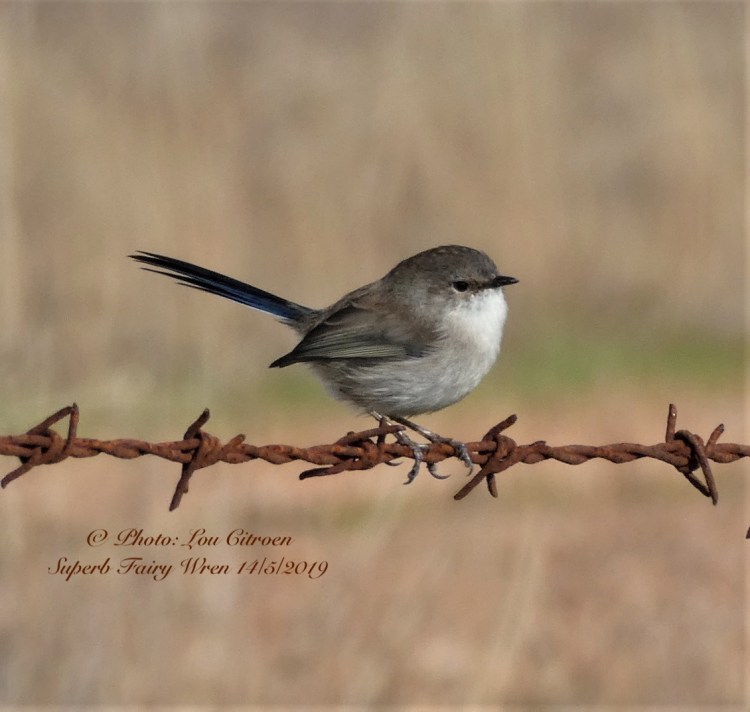
Why the harsh, rusty, barbed wire juxtaposed with a delicate bird?
I hear Leonard Cohen’s song, ‘Bird on a Wire’ when I look at this photo. A song with themes of redemption, being caught by the barbs of sin – others’ and our own, forgiveness and, in all things, trying to be free.
The scene, albeit with a blurred background, resonates with me because it is typical of the Australian bush. I was reared in and by the bush. It gave inspiration to my imagination, it was my playground, my retreat and my succour. On my wanderings through the scrub paddocks, the discovery of a beautiful flower, pretty birds or a coloured glass bottle felt like the discovery of a secret treasure placed there just for me. Childhood taught me that there were more barbs to be found in the family farmhouse than outside it. The bush was my solace and a ‘Choose your own Adventure’ hideaway.
There have been barbs, too, along life’s journey. Barbs inflicted by disabling migraines and disabling mental health (both conditions responding well to new treatments, praise God, but there have been decades of struggle). There have been barbs encountered in a marriage of two imperfect people from two very different backgrounds with two very different temperaments (but in Him, these times of discord are also overcome, praise God). The barbs of harmful bullying in the workplace. The barbs of broken friendships and relationships. And, of course, the barbs of loss – known to each and every one of us.
My name, Reneé means 'born again' in French.
Surely my atheist mother didn't realise this when she named me?
I knew all was well whenever my family called me 'Ren'.
Delighting in the beauty and nature of the Australian bush, it's not so much of a stretch to spell my nickname 'Wren', is it?
My husband and old friends write - 'Dear Wren . . . .'
The photo above is of an Australian Wren (actually a Superb Fairy Wren no less!) in the Australian bush.
The Wren sitting there on the rusty barbed wire is delicate, soft and pretty and yet at the same time, it looks sure, steady and strong. Isn’t that what our God does from the barbs we have experienced? Doesn’t he refine us, mould us and make us like his son?
This scene contrasts the beauty of God’s creation with the rusty barbed wires of this broken world. I am reminded that no matter how awful something may be, or the extent of human suffering and sin, I can lift my eyes to our God whose nature is unchanging, who is always just, merciful, good, perfectly wise and knowing. He has time in his hands and is not unmoved by human suffering. In fact, he gave his own son to rescue all humankind from this suffering once and for all.
It also reminds me of the writer, Corrie Ten Boom’s experience:
When I was in a concentration camp in WWII, we had to stand every day for two or three hours for roll-call, often in the icy-cold wind. Once a woman guard used these hours to demonstrate her cruelty. I could hardly bear to hear or see what happened in front of me.
Suddenly a skylark started to sing high in the sky. We all looked up, and when I looked to the sky and listened to its song, I looked still higher and thought Psalm 103:11  'For as the heavens are high above the earth, so great is his steadfast love toward those who fear him.' Suddenly I saw that this love of God was a greater reality than the cruelty that I experienced myself and saw around me.
Now as I enter my 50th year and see any femme fatale powers (imagined or real ) recede, I think of the words from 1 Peter 3:34 –
'Your beauty should not come from outward adornment, such as elaborate hairstyles and the wearing of gold jewellery or fine clothes. Rather, it should be that of your inner self, the unfading beauty of a gentle and quiet spirit, which is of great worth in God's sight.'
A female Wren is brown and dowdy looking. The clock may tick past 50 for me, but I will rest in the possibility of an ‘unfading beauty of a gentle and quiet spirit’ .
‘Bird on a Wire’.
Reneé

 The Ladies Loop